
|
Evaluation of child abuse in a Central Anatolian city of Turkey*
Kamile Marakoglu1,
Selma
Civi2
1Assist. Prof. Dr., 2 Prof. Dr., Department of Family Medicine, Meram Faculty of Medicine, University of Selcuk, Konya, Turkey
|
Abstract
Background: Although child abuse has existed since the beginning of the human history, it only has a 100- year background of being considered as a problem and studies fostering into it. The start of these studies in Turkey is very new and limited data exists. The aim of this study is to determine the frequency and the related factors of child abuse in Konya, a Central Anatolian city of Turkey.
Methods: The study was conducted in five randomly selected primary schools. One thousand one hundred and fifteen students out of 1368 in grades 2-8 were included. A questionnaire including open ended questions for sociodemographic characteristics and the experience for child abuse were completed by the students. Abuse was defined in three categories as emotional, physical and sexual abuse.
Results: Of 1115 students, 264 (23.7%) were abused. There was significant relationship between being abused and low socioeconomic status (p=0.01) and working mother (p=0.0001). Aggressive personality (p=0.02), feeling insecure (p=0.001) and the idea of leaving home (p=0.001) were more frequently observed in abused children than non-abused children. Idea of suicide in abused children was higher than non-abused children (p=0.0001). Abused children had lower academic performance at school than non-abused children (p=0.002) and had less hope for future (p=0.0001).
Conclusion: Child abuse is one of the most common pediatric disorders in all age groups. Family physicians should be aware of the risk factors for child abuse and possible preventive interventions.
Key words: child abuse, emotional, physical, and sexual abuse.
Marakoglu K, Civi S. Evaluation of child abuse in a Central Anatolian city of Turkey.
TJFMPC, 2007;2:23-25.
Introduction
Physical abuse of children in our society is a serious problem that has only recently been recognized by the medical community. The first published report in contemporary medical literature was in 1946, and the term "battered-child syndrome" was coined in 1962.1 In the following years, children who experienced any type of abuse or neglect became regularly encountered.1,2 Subsequently, child abuse became recognized as a social problem in both developed and developing countries of the world.3 Child
abuse can be defined as causing or permitting any harmful or offensive contact on a child's body; and,
any
communication
or
transaction
of
any
kind
which
humiliates,
shames,
or
frightens
the
child.
Some
child
development
experts
go
a
bit
further,
and
define
child
abuse
as
any
act
or
omission,
which
fails
to
nurture
or
in
the
upbringing
of
the
children. This state is a behaviour disorder, also accepted by the experts as an abuse, preventing the child’s physical, psycho-social development and isolating him/her from the cultural values of his/her society.4-7 While the prevalence of child abuse vary from country to country and between races2-14, it has been determined as 14-54% in Turkey.5,6,13-16
Child abuse includes emotional, physical, sexual abuse and neglect. The National Center on Child Abuse and Neglect has established a set of working definitions of the various types of abuse; however, the specific acts that constitute the various forms of abuses are defined under state law and, thus, vary from one jurisdiction to another. For this reason, child abuse is a legal finding, not a diagnosis.4
Emotional abuse includes the failure of a caregiver to provide an appropriate and supportive environment, and includes acts that have an adverse effect on the emotional health and development of a child. Such acts include restricting a child’s movements, denigration, ridicule, threats and intimidation, discrimination, rejection and other nonphysical forms of hostile treatment. They may also have a potential of harm on the child’s cognitive, emotional and physical development. It is the most difficult to define but the most common abuse type. Some examples are; rejecting, despising, leaving alone, misleading, picking, scaring, intimidating, threatening, leading to crime, not meeting needs, frequently criticizing, expecting more responsibility, humiliating, making fun, nicknaming, pressure and trying to be authority.4,7
The National Center on Child Abuse and Neglect defines child physical abuse as: "The physical injury or maltreatment of a child under the age of eighteen by a person who is responsible for the child's welfare under circumstances which indicate that the child's health or welfare is harmed or threatened thereby…" Some examples are; punching, hiting, kicking, throwing, slapping, using belt, pan, hose, strap, cigarette, iron or any other hot object. It is the most common and the easiest determined type of abuse.4,7
National Center on Child Abuse and Neglect defines child sexual assault as: "Contacts or interactions between a child and an adult when the child is being used for sexual stimulation of the perpetrator or another person when the perpetrator or another person is in a position of power or control over the victim." It is the most difficult to determine and the most hidden type of abuse and it is considerably an important event in terms of its short and long term effects. It constitutes of many behaviours including sexy speaking, showing sexual organ or doing masturbation, exhibiting, explicitly or implicitly peeping, touching, oral-genital
sex,
interfemoral affair, sexual exploitation, pornography and raping.4,7
It has been reported that 25.0% girls and 15.0% boys are exposed to sexual abuse before puberty.17,18 In USA at least,
100.000–500.000 children a year are exposed to abuse.6,19 Sexual abuse rates tend to rise after the onset of puberty, with the highest rates occurring during adolescence.20,21 In a nationwide telephone survey of 2000 children aged 10-16 years in the United States 23.5% of girls and 9.6% of boys reported being subjected to a completed or attempted sexual assault at least once.22
The abused children may show inharmonious and striking manners like getting away from family, being tense, developing dependant character, developing feelings like being valueless.7 Depression, social problems, high levels of distress, rigidity, unhappiness, loneliness, emotional and behavioral problems may develop in children who are exposed to abuse.4,6,8,10,23,24
Risk factors for child abuse are high rates of crime in the society, poor social services, high poverty rate, high unemployment rate, history of physical or sexual abuse as a child for parents, teenage and/or single parent, emotional immaturity, poor coping skills, low self-esteem, substance abuse, poor social support, domestic violence, poor parenting skills, mental health problems, multiple young children, unwanted pregnancy, denial of pregnancy and prematurity, low birth weight and handicapped child.4,25,26 Although child abuse has existed since the beginning of the human history, it only has a 100-year background of being considered as a problem and studies fostering into it. The data on child abuse in Turkey is scarce because of the inadequate records. Although child neglect and abuse is a broad subject, physical abuse steps forward within all the abuse types.
The aim of this study was to find out the prevalence and related factors for child abuse in primary school students.
Material and
Methods
A descriptive and cross-sectional study was conducted in November 2005-February 2006 to find out the prevalence and related factors for child abuse in five randomly selected urban primary school students aged 8-14 years in Konya city of Turkey. Approval and consent were obtained from the Department of Education in Konya. Of 1368 students, 1115 (81.5%) participated in the study. They were in grades 2-8. The first grade teachers did not give consent.
First, information on child abuse was given to teachers and students by a family physician. Then students completed questionnaires on child abuse without giving their names. The teachers added information on the student’s school performance and personality. The sociodemographic information was included in the questionnaire. The open-ended questions on child abuse included the type of abuse, the features of abuser and their future expectations.
Statistical analysis
Data were analyzed using SPSS
software (version 11). The chi-square test and student’s t test were used. Significance was judged as p≤0.05.
Results
Sociodemographic
details
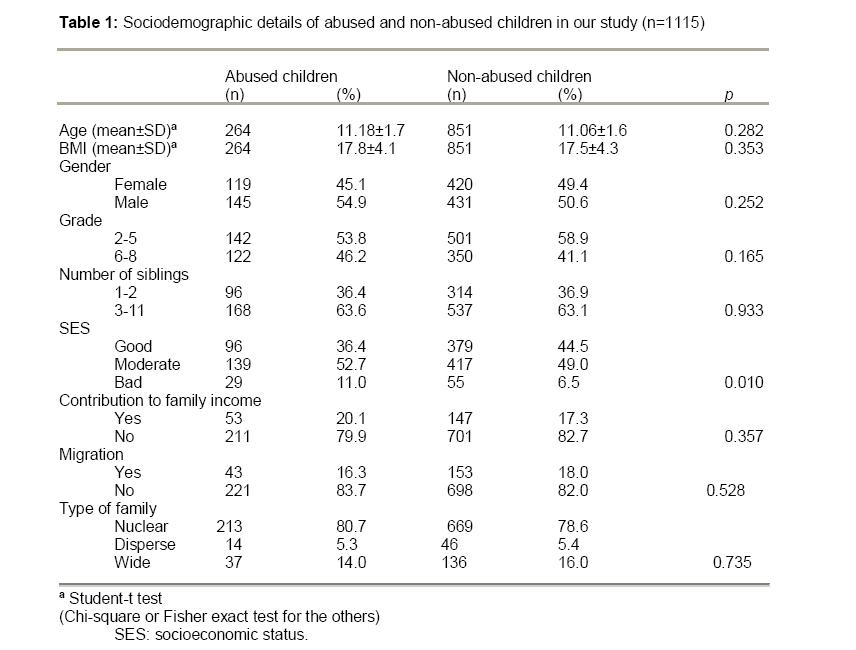
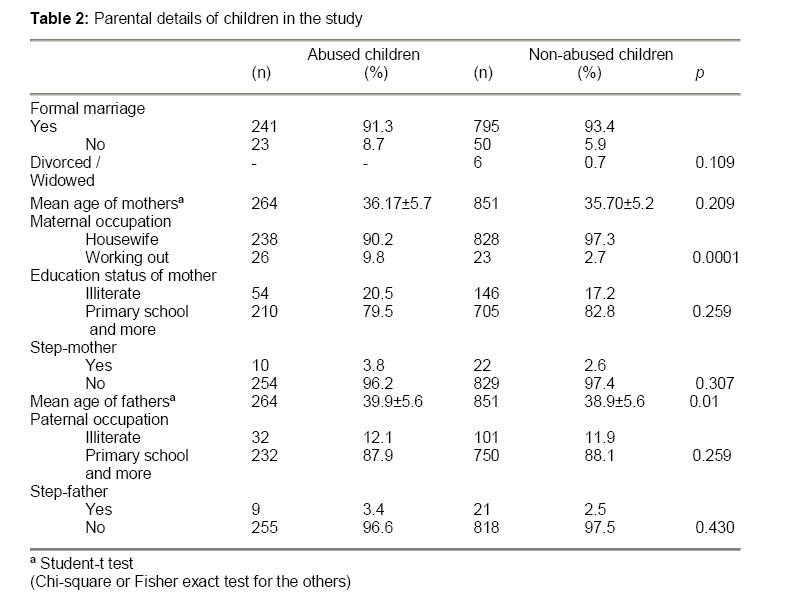
The age, gender and body mass index (BMI) of abused and non-abused children were similar (Table 1). Low socioeconomic status in abused children was higher than non-abused children (p=0.010). There was significant relationship between parental occupation and child abuse (p=0.0001 for mothers, p=0.002 for fathers) (Table 2).
Prevalence of child abuse
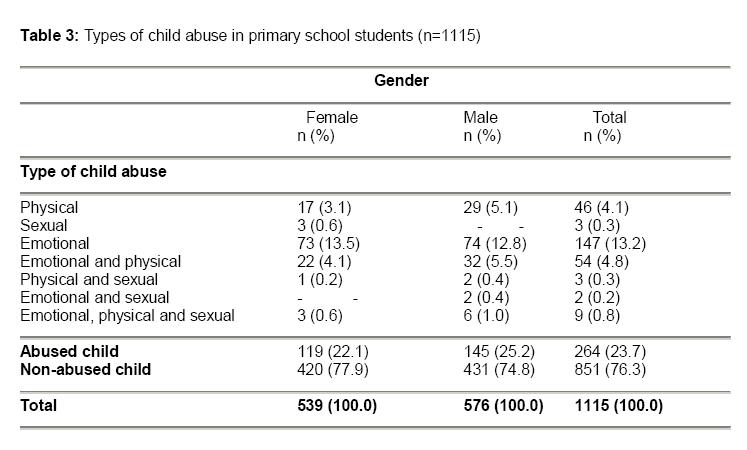
Two hundred and sixty-four (23.7%) out of 1115 students stated that they have been exposed to one or more type of abuse. The prevalence and type of child abuse in these 264 students are presented in Table 3. The number of students experiencing physical abuse was 112 (10.1%), emotional abuse 210 (18.8%) and sexual abuse 15 (1.3%) in 1115 students.
Emotional abuse
Males constituted 52.9% (111/210) and females 47.1% (99/210) of the abused children. The mean age was 11.13±1.7 years (range=8-14). The question ‘Why do you think you are exposed to emotional abuse?’ was asked to abused children and 22.9% (27/118) expressed “committing crime” and 18.6% (22/118) “being aggressive”. “How did you react?” was asked and 24.9% (57/127) said they kept silent, 18.9% (24/127) stated that they cried. Of abused children, 8.9% (16/179) expressed the violence frequency as everyday, 15.1% (27/179) once a week, 33.0% (59/179) once a month, 38.5% (69/179) once in 2-3 months and 4.5% (8/179) once a year. The abusers were fathers in 37.7% (43/114) of students, mothers 31.6% (36/114), elder siblings 14.9% (17/114), other relatives 5.3% (6/114), step parents 0.9% (1/114) and individuals out of family 9.6% (11/114).
Physical abuse
Males represented 65.2% (73/112) and females 34.8% (39/112) of the abused children. The mean age was 11.03±1.7 years (range=8-14). The question ‘Why do you think you have been exposed to physical abuse?’ was asked to the abused children and 23.2% (26/84) replied because of ‘committing crime’, 12.5% (14/84) ‘rejecting’. The response rate was 75.0% (84/112). The question ‘How did you react?’ was asked and 26.0% (32/84) stated that they kept silent, 23.7% (30/89) cried. The frequency was everyday for 9.2% (9/98) of students, once a week for 25.5% (25/98), once a month for 28.6% (28/98), once in 2-3 months for 31.6% (31/98) and once a year for 5.1% (5/98). The abusers were mothers in 39.1% (34/87), fathers in 31.0% (27/87), elder siblings in 14.9% (13/87), other relatives in 6.9% (6/87) and individuals out of family in 8.0% (7/87).
Sexual abuse
Males were 53.3% (8/15) and females 46.7% (7/15) of the abused children. The mean age was 10.0±1.5 years (range=8-13). ‘Why do you think you are exposed to sexual abuse?’ was asked and 42.9% (3/7) answered as ‘I don’t know’ and 28.6% (2/7) ‘being young’. ‘How did you react?’ was asked and 60.0% (6/10) of students said they kept silent, 20.0% (2/10) stated that they tried to keep away and 20.0% (2/10) resisted. We have no data on the frequency of abuse and the identity of abuser.
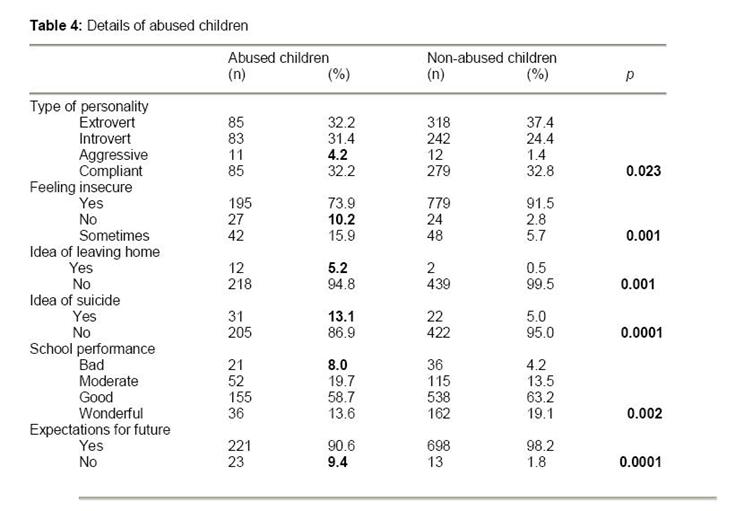
Aggressive personality (p=0.023), feeling insecure (p=0.001) and the idea of leaving home (p=0.001) and suicidal thought (p=0.0001) were more frequent in abused children than non-abused ones. School performance was lower in abused children (p=0.002) and they had less hope for future (p=0.0001) (Table 4).
Discussion
Between 1985 and 1993, the number of cases of child abuse in the United States increased by 50 percent. In 1993, three million children in the United States were reported to have been abused. Thirty-five percent of these cases of child abuse were confirmed.4 According to the 1996 National Committee Report, 57% of cases were neglect and emotional abuse, 25% physical, 11% sexual and 7% was other types of abuse.4
In studies, it has been determined that emotional abuse is frequently seen with other types of abuse and can reach up to 85.0%. The prevalence of emotional abuse in our study is concordant with literature.4,6,14,15,27
In a study carried out at Zimbabwe primary schools, physical abuse rate in schools in 1995 was 34.8%.8 In a study in Egypt, 37.0% of children reported being beaten or tied up by their parents and 26.0% reported physical injuries such as fractures, loss of consciousness or permanent disability as a result.9
In a recent study in the Republic of Korea, two-thirds of parents reported whipping their children and 45.0% confirmed that they had hit, kicked or beaten them.10
In a study in Romania, it was found that 4.6% of children reported suffering from severe and frequent physical abuse, including being hit with an object, being burned or being deprived of food. Nearly half of Romanian parents admitted beating their children ‘regularly’ and 16.0% beating their children with objects.11
In Ethiopia, 21.0% of urban school children and 64.0% of rural school children reported bruises or swellings on their bodies resulting from parental punishment.12
In a study carried out in 8 cities of Turkey in 1980-1982 among 16100 children, the prevalence of child abuse was found as 33.0%. The prevalence changes with geographical region; 14.0% in the Western and 54.0% in the Eastern Anatolia.5
In a study at pediatric psychiatry clinic in Turkey, the prevalence was 36.1%; 58.0% physical, 21.5% emotional abuse and 20.5% both. Sexual abuse could not be questioned. There was significant relationship between socioeconomic status and child abuse, paternal occupation and abuse. The main risk factors were physical illness of the child, bad-tempered child, incompatibility in the family and the psychological illness of the mother. One fourth of admissions were for low school performance supporting the idea that the low school performance was related to abuse.4,6,8,10
In a study in 3725 primary school students in Elazig city, Turkey, 74.0% of the students (51.7% boys, 33.9% girls) expressed exposure to physical violence at least once in their lives, 43.4% occasional, 33.1% once or twice a week, 2.1% every day physical abuse.13 During the last year, 17.3% of students were exposed to physical abuse by mother, 13.9% by father, 19.8% by teacher.
The prevalence in our study is consistent with national and international studies.4-13
A study Quasem et al14 from Kuwait showed that 86% parents believe in the importance of physical punishment in child discipline.
In a study from Turkey, children declared the rate of physical punishment as 61.0% for their mothers and 40.0% for fathers whereas mothers’ declaration was 9.0% and fathers’ 3%.15 In another study by Aral et al16 from Turkey, it was determined that 65.7% of children were exposed to physical abuse by parents. The identity of the abuser in our study is consistent with national and international studies indicating that violence is considered as normal by the parents.
Although national and international studies13,28
state that physical abuse is higher in boys than girls we could not find a significant difference.
In a study from Turkey, it was found that abuse types were distributed as; 85.0% emotional, 66.0% physical and 38.0% sexual. Our rates are quite lower than rates in the literature.
Low education and SES, psychological problems of parents, serious incompatibility in family, violence in family, alcohol use of parents, unemployment and separation were stated as risk factors.4,6,12,29
In Finland, 7.6% of girls and 3.3% of boys stated experiencing sexual abuse.30 In a study in Geneva it was %11.0 for boys and 2.5% for girls.31 Our result for sexual abuse rate being lower than other studies may be due to traditional structure of Turkish society and underreporting.
In our study, maternal occupation was related to abuse suggesting that it may be due to poor social support..
There are few studies on child abuse in our country. Further studies are needed. Individual, social and global preventive interventions are important for child abuse. Family physicians have great role in diagnosing and preventing child abuse.
Acknowledgements
This study was supported by Selcuk University Faculty of Medicine and Department of Education in Konya. We thank to the school directors, teachers and students in the study.
References
1. Kempe CH, Silverman FN, Steele BF,
Droegemueller W, Silver HK. The
battered-child syndrome. JAMA 1962;181:17-24.
2. Alexander RC. Current and emerging concepts in child abuse. Compr Ther 1995;21:726-30.
3. Finkelhor D, Korbin
J. Child abuse as an international issue. Child Abuse Negl
1988;12:3-23.
4. Bethea L. Primary Prevention of Child Abuse. Primary prevention of child abuse.
Am Fam Physician 1999;59:1577-85..
5. Bilir S,
Ari M, Donmez NB, Guneysu S. A study on injured cases in 16100 children aged 4-12. Journal of Child Development and Education 1986;1:7-14 [in Turkish].
6. Oral R, Yavuz S, Can D, Kutlugun
A, Genc I. Frequency of child abuse in a child psychiatry clinic. Cukurova University Medicine Faculty Journal 1997;2:137-44
[in Turkish].
7. Child abuse and neglect. World Health Organization. Accessed: August 8, 2006. Available from URL: http://www.who.int/violence_injury_prevention/violence/neglect/en/.
8. Shumba A. Epidemiology and etiology of reported cases of child physical abuse in Zimbabwean primary schools. Child Abuse Negl
2001;25:265-77.
9. Youssef RM,
Attia MS,
Kamel MI. Children experiencing violence: parental use of corporal punishment. Child Abuse Negl
1998;22:959-73.
10. Hahm HC, Guterman NB. The emerging problem of physical child abuse in South Korea. Child Maltreat 2001;6:169-79.
11.
Browne KD, Cartana C, Momeu L, Paunescu G, Petre N, Tokay R. Child abuse and neglect in Romanian families: a national prevalence study 2000. Copenhagen, WHO Regional Office for Europe, 2002.
12. Ketsela T, Kebede D. Physical punishment of elementary school children in urban and rural communities in Ethiopia. Ethiop Med J
1997;35:23-33.
13. Deveci SE, Acik Y. Physical violence exposure and approaches of primary school students II. Firat University Faculty of Medicine Department of Social Health [in Turkish]. Accessed: September 15, 2006. Available from URL: http://www.dicle.edu.tr/~halks/m9.30.htm.
14.
Quasem FS, Mustafa AA, Kazem NA, Shah NM. Attitudes of Kuwaiti parent toward physical punishment of children. Child Abuse Negl 1998;22:1189-202.
15. Bahar Z, Bayik A.
Mothers’ attitudes towards reward and punishment in child education. Journal of Ege University Nursary Education 1985;1:1-13 [in Turkish].
16. Aral N. Physical abuse and child. Tekisik Press, Ankara, 1997
[in Turkish].
17. Thakkar RR,
Gutierrez PM,
Kuczen CL,
McCanne TR. History of physical and/or sexual abuse and current suicidality in college women. Child Abuse Negl 2000;24:1345-54.
18. Egemen A. A legal and social approach to sexual abuse in Turkey. Journal of Child Health and Disease
1993;36:285-8 [in Turkish].
19. Fuller AK. Child molestation and pedophilia. An overview for the physician. JAMA
1989;261:602-6.
20. Finkelhor D. Current information on the scope and nature of child sexual abuse. The Future of Children 1994;4:31-53.
21. Olsson A, Ellsberg M, Berglund S, Herrera
A, Zelaya E, Pena R et al. Sexual abuse during childhood and adolescence among Nicaraguan men and women: a population-based anonymous survey. Child Abuse Negl 2000;24:1579-89.
22. Finkelhor D, Dziuba-Leatherman J. Children as victims of violence: a national survey. Pediatrics
1994;94:413-20.
23. Hay T, Jones L. Societal interventions to prevent child abuse and neglect. Child Welfare 1994;73:379-403.
24. Donohue B, Romero V, Hill HH. Treatment of co-occurring child maltreatment and substance abuse. Aggress Violent Beh 2005;11:626-40.
25. Steinberg LD, Catalano R,
Dooley D. Economic antecedents of child abuse and neglect. Child Dev 1981;52:975-85.
26. Understanding child abuse and neglect. Panel on Research on Child Abuse and Neglect, Commission on Behavioral and Social Sciences and Education, National Research Council. Washington, D.C.: National Academy Press, 1993.
27. Leventhal JM. Sexual abuse of children. In: Hoekelman RA, Friedman SB, Nelson NM, Seidel HM, Weitzman ML (eds). Primary Pediatric Care. 3rd ed. Mosby: 1997; 651-55.
28. MacMillan HL, Fleming JE, Trocme N, Boyle MH, Wong M, Racine YA et al.
Prevalence of child physical and sexual abuse in the community. Results from
the Ontario Health
Supplement. JAMA 1997;278:131-5.
29. Oral R, Hanci H, Can D, Kaplan S, Miral S, Tepeli N et al. An 18 month experience of Izmir child abuse research group on child abuse cases in Izmir Education Hospital. Accessed: September 15, 2006. Available from URL: http://www.med.ege.edu.tr/~hanci/istismargrup.htm
[in Turkish].
30. Sariola H, Uutela A. The prevalence of child sexual abuse in Finland. Child Abuse Negl 1994;10:827-35.
31. Halperin DS,
Bouvier P,
Jaffe PD,
Mounoud RL,
Pawlak CH,
Laederach J
et al. Prevalence of child sexual abuse among adolescents in Geneva: results of
a cross sectional survey. BMJ 1996;312:1326-9.

CORRESPONDING AUTHOR
Assist. Prof. Dr. Kamile Marakoglu
Selcuk University Meram Faculty of Medicine
Department of Family Medicine 42080 Konya Turkey
Phone: + 90
332 223 64 77
Fax: + 90
332 223 61 81
E-mail: kmarakoglu@yahoo.com, kmarak@selcuk.edu.tr.
Submitted date: 19.04.2007 Accepted date: 30.05.2007
